R.Keimel Osterreichs Luftfahrzeuge (Weishaupt Verlag)
Petročzy-Kàrmàn-Zurovec PKZ 2 1918
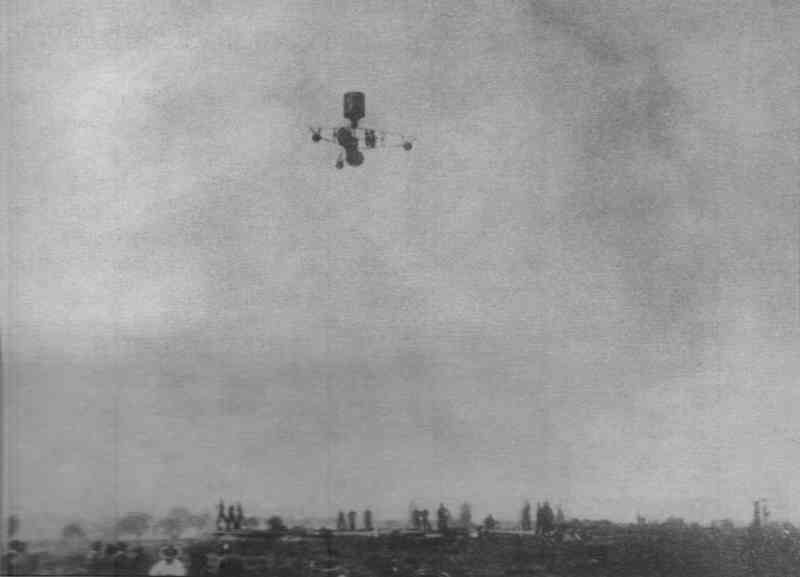
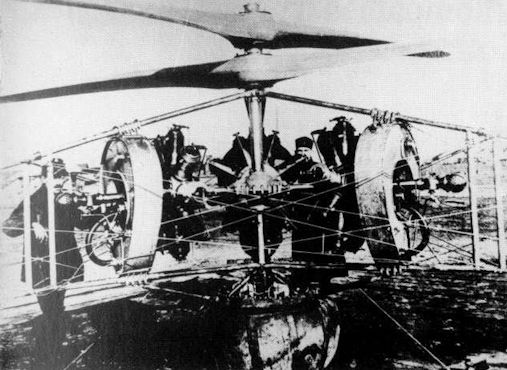
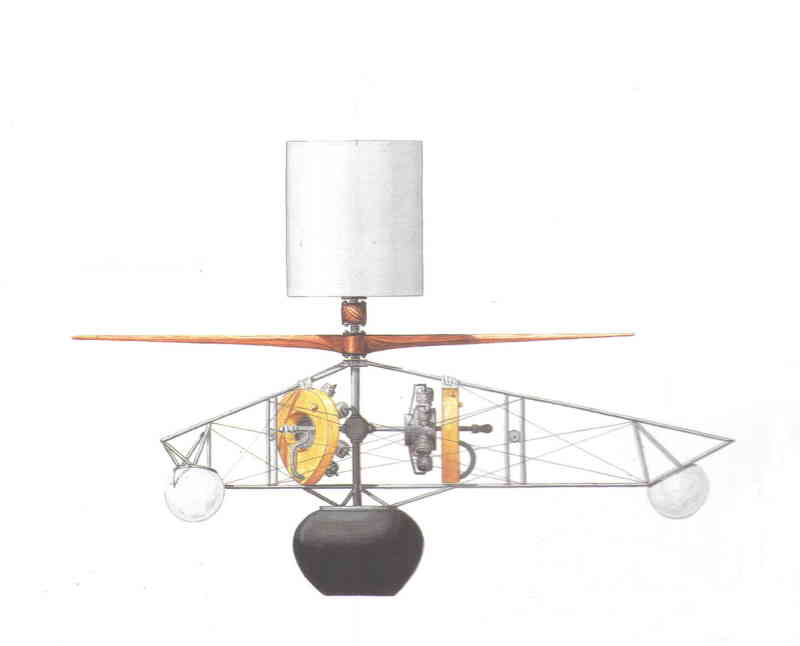
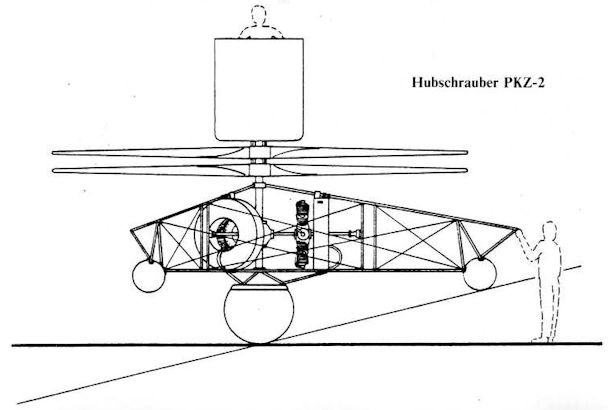
Петроци, Карман и Журовец развили конструкцию платформы PKZ 1. Поскольку электродвигатель оказался слишком слабым для дальнейших испытаний и сгорел, на новую раму установили три ротативных двигателя. Они приводили в движение два соосных несущих винта противоположного вращения. Над ними располагалась платформа для наблюдателя. Привязка к земле осуществлялась с помощью трёх постоянно натянутых тросов. Были достигнуты получасовые полёты висения на высоте 50 м. На тот момент этот аппарат был самым успешным вертолётом.
Производитель: K. u. k. Fliegerarsenal Flugzeugwerk Fischamend (Императорский и королевский авиационный арсенал, авиационный завод Фишаменд) / Dr. Liptak & Co. AG., Pestszentlörincz, Венгрия.
Назначение: Армейский привязной вертолёт-наблюдатель.
Построен: 1917-1918
Количество: 1 экземпляр
Первый полёт: 2 апреля 1918
Экипаж: 1
Двигатель: 3 × 88 кВт (120 л.с.) Le Rhône, 9-цилиндровый ротативный, привод двух соосных двухлопастных винтов противоположного вращения.
Размеры:
Диаметр несущего винта: 6,00 м
Ометаемая площадь: 2 × 28,2 м²
Веса:
Макс. взлётный вес: 1400 кг
Нагрузка на ометаемую площадь: 49,7 кг/м²
Нагрузка на мощность: 5,3 кг/кВт
Запас топлива: 140 кг
Достигнутая высота: 50 м
Продолжительность полёта: 1 ч
Показать полностью
P.Grosz, G.Haddow, P.Shiemer Austro-Hungarian Army Aircraft of World War One (Flying Machines)
PKZ 2 Helicopter
The Petroczy-Karman-Zurovec PKZ 2 helicopter, despite its name, was invented by Wilhelm Zurovec for which he alone received German patent No.347,578, dated 12 February 1918. Unlike the PKZ 1, which was government funded, the PKZ 2 was privately financed by the Hungarian Bank and the firm of Dr. Liptak & Co AG, a large iron foundry and steel fabricator located near Budapest which established an experimental section under Zurovec's direction in late 1917.
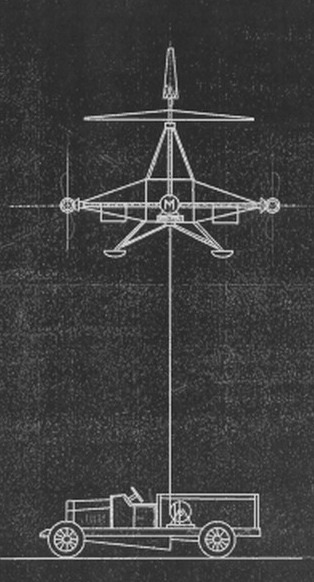
In the design of the PKZ 2 helicopter, Zurovec incorporated the concept of using counter-rotating rotors to cancel torque effects. Each rotor, with a diameter of 6 meters (19 ft 8 in), represented an ingenious combination of old-world craftsmanship with modern applied engineering. Power was supplied by three 100 hp Gnome rotary engines, that drove the rotors at 600 rpm through a common gearbox. The light, tubular airframe, easily disassembled for transport, rested on a patented central air-bag cushion (1 meter diameter) and three smaller cushions mounted on the outriggers. The cushions were kept inflated by an air pump attached to the rotor drive. Three tethering cables affixed to the outriggers ran through pulleys anchored in the ground and were controlled by separate, electric winches. The total weight of the PKZ 2 with fuel for one hour, but without observer and machine gun, was approximately 1200 kg. Two forms of parachute rescue were planned. One was to carry the observer and aircraft safely to earth, and the other was a cannon-launched parachute that would clear the rotors and lift the observer to safety.
The PKZ 2 was test flown for the first time at the Liptak factory on 2 April 1918. After several flights, one lasting up to one hour, tests were suspended on 5 April because engine power was insufficient to permit safe hovering above 1.2 meters height. The Gnome engines were replaced by three 120 hp Le Rhones. Flight testing continued from 17 to 21 May, during which flights between 10 and 50 meters altitude were recorded. During periods of calm weather and smooth engine operation, the excess lift measured at ground level was 150 to 200 kg. As the PKZ 2 climbed, the loss of ground effect and the increase in tethering cable weight steadily reduced the excess lift. Yet, as long as excess lift sufficed to maintain proper cable tension, the PKZ 2 remained in stable hovering flight. At higher altitudes, the excess lift became marginal, causing the machine to slowly oscillate with increasing amplitude. Provided the tethering cables were retracted at about 1,5 meters/second, the oscillations to cease in about 15 to 20 seconds.
On 10 June 1918, Zurovec was called upon to demonstrate the PKZ 2 for high ranking military authorities. Although the rotary engines had recently been overhauled, their operation the day before was erratic, and Zurovec, fearing the worst, was reluctant to proceed. But what could a mere Leutnant do against the weight of official brass eager to see the wonder machine fly? Taking advantage of the zero wind conditions, the PKZ 2 with the observer's basket in place took-off at 5:40 am and twice rose to 7-8 meters height, showing "considerable rocking motion." The basket was removed and the PKZ 2 took off again at 6:07 am in a wind of 6-7 meters per second, climbing to a height of 12 meters. Due to overheating, the engine power dropped off and the helicopter began to pitch with increasing frequency until the tether-winch crew could no longer control the machine. The PKZ 2 crashed from two meters height, severely damaging the airframe and splintering the rotors. In a careful review of progress to date, Uzelac, realizing that the technical problems were too complex to resolve quickly, cancelled the project on 21 June 1918. Zurovec, Karman, and Liptak were directed to compile a record that would be a basis for further investigation when peace returned. Zurovec, refusing to accept defeat, devised a method to water-cool the rotary engines! He reported on 1 September that the PKZ 2 helicopter would be ready for further testing on 1 November 1918. By then it was too late.
Karman-Zurovec Remote-Control Helicopter
An unmanned helicopter design based on the Karman-Zurovec concept was proposed in September 1917. Driven by an electric motor, it was designed to carry aloft meteorological instruments and wireless equipment for gathering weather data and communicating in mountainous areas. Flars reported that the remote-control helicopter, now powered by a single Gnome rotary engine, would be ready for flight testing in mid-February 1918. Further information is lacking.
Показать полностью
E.Hauke, W.Schroeder, B.Totschinger Die Flugzeuge der k.u.k. Luftfahrtruppe und Seeflieger 1914-1918
Das verbesserte Modell 2 war im Gegensatz zum Typ 1, der aus einer geraden Rohrkonstruktion mit vier in Reihe angeordneten Hubpropellern bestand, dreieckig symmetrisch mit drei Umlaufmotoren (je einer in einem Ausleger, ursprünglich 100 PS-Gnöme) ausgelegt und vollführte unzählige Starts bis zur Höhe von 50 m (an drei Stahlseilen gefesselt). Als Rotor dienten zwei gegenläufig angeordnete Hubpropeller, die von den drei zusammengekoppelten Umlaufmotoren angetrieben wurden, und ein Beobachtungsstand war über den Propellern angebracht. Der Zusammenbruch der Donaumonarchie verhinderte jedoch eine erfolgreiche Weiterentwicklung.
В отличие от типа 1, который состоял из прямой трубчатой конструкции с четырьмя подъемными винтами, расположенными в ряд, улучшенная модель 2 имела треугольную симметрию с тремя роторными двигателями (по одному в стреле, первоначально Gnome мощностью 100 л.с.) и выполнила бесчисленное количество полетов до высоты 50 м (привязан к трем стальным тросам). Ротором служили два винта, вращающихся в противоположных направлениях, которые приводились в движение тремя роторными двигателями, соединенными вместе, а над винтами была установлена смотровая площадка. Однако крах дунайской монархии помешал дальнейшему успешному развитию.
Sonderkonstruktionen
P.K.Z. Type 2 Hubschrauber 1 Stück 3 x Gn 100/Rh 110
Показать полностью