J.Davilla, A.Soltan French Aircraft of the First World War (Flying Machines)
Breguet 13 and 14
Civil Versions of the Breguet 14:
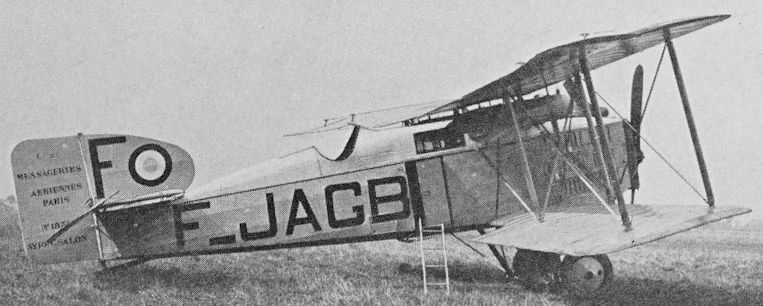
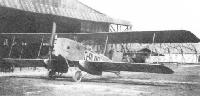
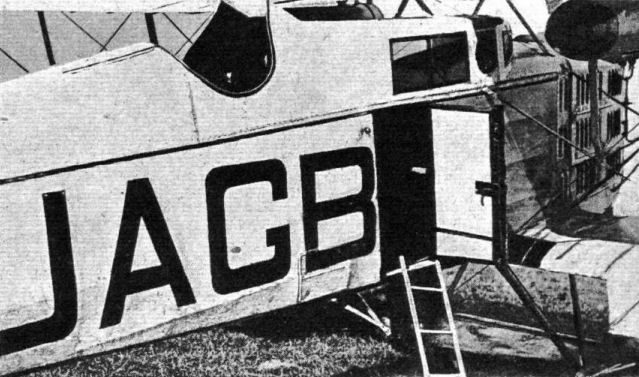
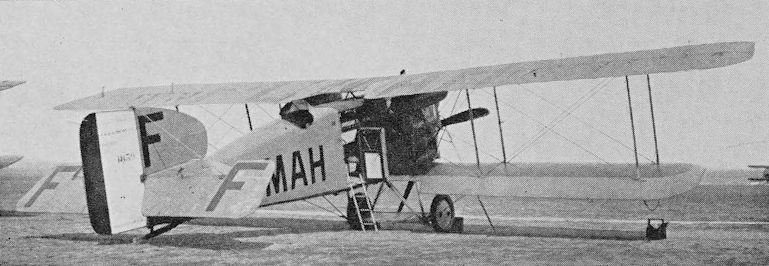
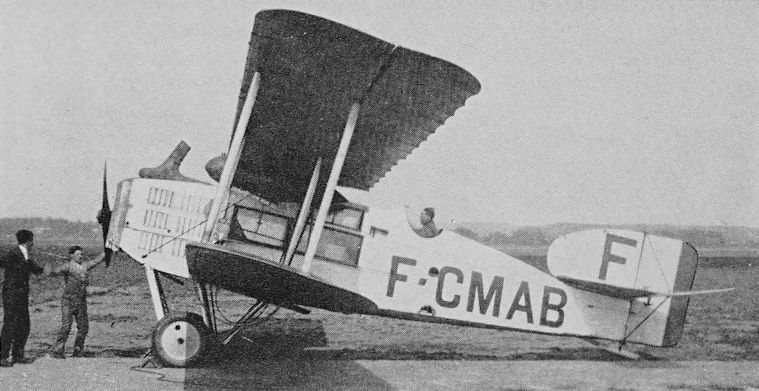
Breguet 14 T - This was a conversion of the basic Breguet 14, capable of carrying two passengers in a cabin in from of the pilot's cockpit. The entrance door was on the starboard side of the fuselage. An ambulance version that had the stretchers located in a cabin ahead of the pilot was also produced.
Breguet 18 T - This was an enlarged 14 T with a 450-hp Renault 11Ja engine. It had an enlarged cabin that could carry four passengers.
Breguet 14 T bis - This version was a hybrid of the previously mentioned 14T and 18T. It had a cabin that carried three passengers.
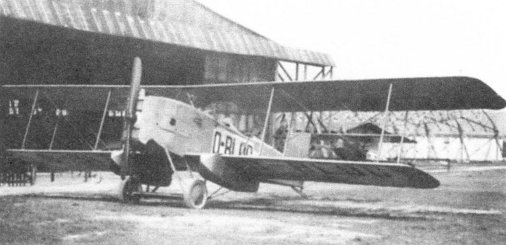
Civil operators of the Breguet 14s included Cie des Transports Aeriens Guyanais - five T bis; Swedish Red Cross - two T bis; Lignes Aeriennes Latecoere - 106 T and T bis (some of these were converted to carrying mail and were known as the Torpedo or Breguet Latecoere); SNETA - this Belgian airline operated three Breguet 14 A2s with 180-hp engines; Compania Rioplatense de Aviation - used Breguet 14s on the Buenos Aires-to-Montevideo service in 1921.
Показать полностью
J.Stroud European Transport Aircraft since 1910 (Putnam)
Breguet 14 and 18T
<...>
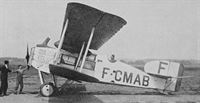
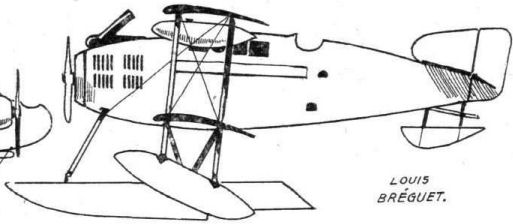
A float version of the Breguet 14T was exhibited at the Paris Aero Show in 1919. Also on view was a larger version of the landplane 14T, this was the Breguet 18T Berline, which was a three-bay biplane with a 450 hp Renault 12Ja engine and a cabin for four passengers, the example shown being F-CMAX. This may have been used by CMA, but was considered generally too ambitious for its time, and was developed into the 300 hp Breguet 14T2 with a cabin for three passengers.
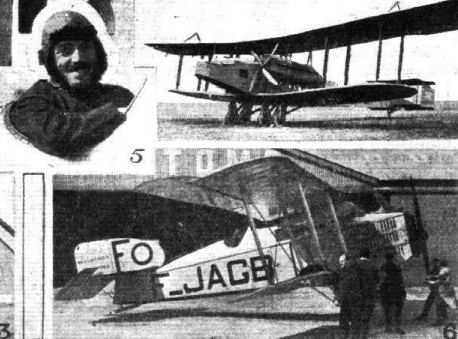
In 1921 a new version of the Breguet 14 was developed. This was the 14Tbis, which was a combination of the 14T and 18T. It had an improved cabin with four large windows on each side and four circular windows in each side of the upper decking in place of the older rectangular windows. The first 14Tbis, F-CMAL (c/n 1842), is reported as having made its first flight on 13 September, 1921. Judging from its registration, this would appear to have been a 14T2 rebuilt.
In the cabin Breguets the fuel tanks were removed from the fuselage and torpedo-shaped tanks were mounted underneath the upper wing between the fuselage and the inner set of interplane struts.
In French Guiana, Cie des Transports Aériens Guyanais used at least five Breguet 14Tbis cabin floatplanes. These had a large central float, stabilizing floats at mid-span and a small tail float. They worked services from St Laurent to Cayenne and Inini. Two other Breguet 14Tbis aircraft were used by the Swedish Red Cross - they could operate with wheel, float or ski undercarriage.
Immediately after the war Lignes Aériennes Latécoére (Cie Générale d’Entreprises Aéronautiques) founded by Pierre G. Latécoére began the practical development of regular service to South America. The first section, from Toulouse to Barcelona via Perpignan, was opened on 25 December, 1918. The extension to Rabat via Alicante, Malaga and Tangier opened on 1 September, 1919, and Casablanca was served regularly from April 1920. A Casablanca - Rabat-Fez - Oran service began in October 1922 and Toulouse-Alicante-Oran and Marseilles-Perpignan services early in 1924. In June 1925 the main route was opened through Agadir, Cap Juby, Villa Cisneros, Port Etienne and St Louis to Dakar. Most of these operations were undertaken by Breguet 14s, and the Latécoére company employed no less than 106 of these aircraft, with 97 on charge at the end of 1923.
Some of these Breguets were specially converted, by Latécoére, for mail carriage. They had a single cockpit, and beneath each lower wing a streamlined mail container. This type was known as the Breguet 14 Torpédo or Breguet Latécoére. It has been reported that Latécoére built Breguet 14s, and constructor’s numbers have been quoted for them; however, this does not appear to be true. It seems that, having begun operations with war-surplus aircraft still bearing camouflage and military markings, Latécoére embarked on a large-scale overhaul and rebuilding programme. These overhauled aircraft were aluminium doped on all surfaces and bore numbers in the 100, 200 and 300 series on their fins. These numbers were almost certainly fleet unit numbers and not constructor’s numbers. For example, the aircraft bearing the numbers 129, 131 and 157 are known to have had the c/ns 6389, 6365 and 3427, respectively.
The Royal Aeronautical Service of Thailand also used Breguet 14s on domestic mail services which began in 1922. Some had mail containers, but in others the bags were carried on racks on the fuselage side and held in place by nets. It was also reported that cabin Breguet 14s were used for passenger services.
SNETA in Belgium had three open-cockpit Breguet 14A.2s with 280 hp Fiat engines. These aircraft were heavier than the Renault-powered aircraft and had inferior performance.
Compania Rioplatense de Aviacion operated Breguet 14s on Buenos Aires-Montevideo services in 1921.
A number of other companies used Breguet 14s and the type set many records and made numerous outstanding flights in Europe, to the Middle East, and to North and West Africa.
Breguet 14T. Span 14-36 m (47 ft 1 1/4 in); length 9 m (29 ft 6 in); wing area 50 sq m (538-19 sq ft). Empty weight 1,238 kg (2,729 lb); useful load 300 kg (661 Ib); loaded weight 1,984 kg (4,374 lb). Cruising speed at 2,000 m (6,561 ft) 125 km/h (77:6 mph); landing speed 70 km/h (43:4 mph); ceiling 4,500 m (14,763 ft); range 460 km (285 miles).
Breguet 18T. Span 17-42 m (57 ft 1 3/4 in); length 10-1 m (33 ft 14 in); wing area 73:5 sq m (791-14 sq ft). Empty weight 1,600 kg (3,527 Ib); useful load 660 kg (1,455 Ib); loaded weight 2,700 kg (5,952 Ib). Maximum speed at 2,000 m (6,561 ft) 160 km/h (99-4 mph); ceiling 5,200 m (17,060 ft).
Показать полностью
Журнал Flight
Flight, December 25, 1919.
SOME FRENCH MACHINES AT THE SHOW
Societe Louis Breguet
THIS firm is showing three complete machines and one very interesting power unit. One machine is a military two-seater fighter of the famous C 2 XVII type. A seaplane of the A 2 XIV type is also shown, as well as a transport machine of the "Berline" type, XVIII T. This machine, which is a development of the Breguet night bomber, carries six passengers, in addition to the pilot. The engine is a 450 h.p. Renault, with which the machine is capable of a speed, at low altitudes, of 160 kilometres per hour (99 m.p.h.), and a climb of 10,000 ft. in 40 mins. The range is four hours at full throttle, or about 400 miles.
The power unit to which reference has already been made, consists of a novel transmission gear, by means of which the power of four engines of 200 h.p. each is transmitted to a single shaft on which is mounted the airscrew.
Показать полностью