В.Шавров История конструкций самолетов в СССР до 1938 г.
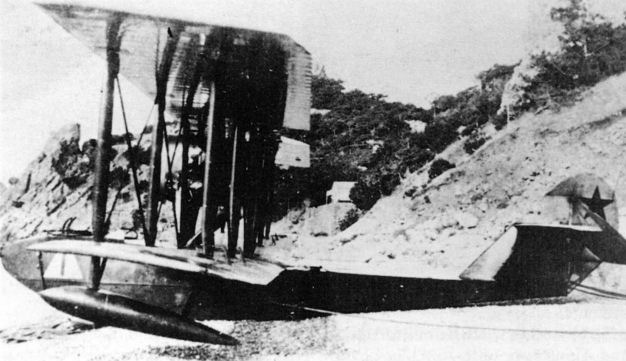
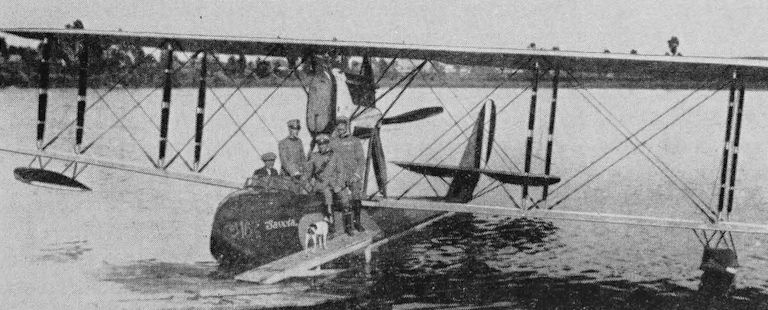
"Савойя" С-16 бис - трехместная летающая лодка-разведчик, двухстоечный биплан с двигателем "Фиат" A-12 бис в 300 л. с. Винт толкающий четырехлопастный. Конструкция - деревянная. Корпус лодки состоял из обычного каркаса и фанерной обшивки толщиной в основном 4 мм, оклеенной полотном. Ниже ватерлинии и по днищу фанера была обшита 4-мм досками шириной около 90 мм. По бортам эти доски были сосновые, по днищу - тополевые (под 45°) и по ним - тиковые. Между слоями их было проложено просмоленное полотно. Все было проклепано медными заклепками, как в поплавках Авро. Лодка была очень прочной. Был случай, когда самолет выдержал на плаву девять суток дрейфа, в том числе три дня шторма. Первоначально самолеты были закуплены в 1923 г., но затем было приобретено еще 50 самолетов, которые применялись до 1931 г. главным образом на Черном море. В 1926-1927 гг. на нескольких самолетах был установлен двигатель "Лоррэн-Дитрих" в 450 л. с. Модернизация называлась С-16 тер. Переделка производилась в OMOC. Скорость возросла, но дальность полета не увеличилась.
Самолет|| С-16 бис/ С-16 тер
Год выпуска||1923/1926
Назначение||Разведчик/Разведчик
Число мест||3/3
Двигатель , марка||/
Мощность, л.с.||300/450
Длина самолета, м||9,97/9,97
Размах крыла, м||15,5/15,5
Площадь крыла, м2||62/62
Масса пустого, кг||1750/1850
Масса топлива+ масла, кг||200+25/240+30
Масса полной нагрузки, кг||750/800
Полетная масса, кг||2500/2650
Удельная нагрузка на крыло, кг/м2||40,3/42,7
Удельная нагрузка на мощность, кг/лс||8/5,9
Весовая отдача, %||30/30
Скорость максимальная у земли, км/ч||165/180
Скорость максимальная на высоте, км/ч||120/140
Скорость посадочная, км/ч||85/90
Время набора высоты||
1000 м, мин||8/6
2000 м, мин||20/14
3000 м, мин||48/32
Потолок практический, м||3500/4000
Продолжительность полета, ч.||4/3,5
Дальность полета, км||550/550
Время виража, с||40/?
Разбег, м||500/400
Пробег, м||250/300
Показать полностью
L.Andersson Soviet Aircraft and Aviation 1917-1941 (Putnam)
Savoia S.16
The Italian Societa Idrovolanti Alta Italia (SIAI) built a long range of successful flying-boats and its first postwar design, the S.16, a six-seat passenger transport flying-boat, appeared in 1919. Designed by Raffaele Conflenti, it was a single-engined two-bay biplane powered by a water-cooled 300hp Fiat A.12bis engine. There were three separate open cockpits for the pilot and passengers in the hull, which had a concave bottom forward of the single step. The lower wings were fitted with ailerons and set at slight dihedral. The engine was mounted with a frontal radiator on a number of struts in a position between the wings, driving a four-blade wooden pusher propeller.
Orders for the S.16 started to arrive after the Paris Air Salon of 1919, some of them from civil customers and others for the two-seat military version intended for reconnaissance and light bombing. The forward cockpit in the bow was equipped with a single machine-gun for the observer (the Soviet examples were fitted with DA machine-guns), mounted on a revolving ring. There were provisions for underwing bomb racks for 220kg of bombs. The S.16bis version had an improved extremely strong hull with triple wooden planking below the water-line with tarred linen between the layers, strengthened wings, a new propeller and increased fuel capacity. At least 100 S.16s were ordered by the Italian Navy and by the Regia Aeronautica and the air services of both the Spanish Army and Navy acquired many from 1921. Ecuador received one in 1924, Latvia six in 1923 and Turkey twenty in 1924.
In order to be able to re-equip the naval reconnaissance units of the RKKVF the Soviet Government placed an order for the S.16bis on 11 December 1922. Thirty-five, of which five were intended as reserve aircraft, were delivered to Sevastopol in 1923, and these were followed by a 36th example in 1924 (c/ns 5018-5046 except one, 5050-5056 and 5065). The first twenty of these were sent to Hamburg by train accompanied by the Savoia test pilot Guarnieri and fourteen arrived by boat in Leningrad in April 1923. The S.16s were assigned to the 3rd Otdel'nyi razvedivatel'nyi gidro-aviatsionnyi otryad at Odessa and the 4th Otdel'nyi razvedivatel'nyi gidro-aviatsionnyi otryad at Sevastopol, which became the 53rd and 64th Aviaotryady in 1927. One of these flying-boats was fitted with a 250- 310hp BMW IV engine for comparative tests but crashed on its second flight on 2 October 1925. Meanwhile, the S.16ter version had been developed in Italy and during 1926-27 GAZ No. 3 in Leningrad was given the task of modifying some thirteen of the S.16s to the same standard. The Soviet S.16ter had a 450hp Lorraine-Dietrich V-12 engine which gave it improved performance.
One S.16 piloted by E M Lukht participated in an expedition to Wrangel Island north of the extreme northeastern part of the Soviet Union in August 1927. It was carried along with Dobrolet's Junkers F 13 R-RDAS on board the steamship Kolyma and was employed for ice reconnaissance. Both aircraft were later flown from Tiksi on the north coast along the Lena River all the way down to Irkutsk. The 53rd Aviaotryad at Odessa was disbanded in 1928 and the 64th at Sevastopol followed suit in 1931. The Savoia flying-boats were handed over to other units for use as trainers. A number of S.16s had been assigned to the School of Naval Pilots at Sevastopol/Eisk for advanced training and to these were added a few remaining from operational units in 1933. The Eisk school still had seven on charge by the beginning of 1934.
S.16bis (S.16ter)
300hp Fiat A.12bis (450hp Lorraine-Dietrich)
Span 15.5m; length 9.97m; height 3.67m; wing area 60 nv
Empty weight 1,670 (1,850) kg; loaded weight 2,570 (2,650) kg
Maximum speed 165 (190) km/h; cruising speed 120 (140) km/h; alighting speed 85 (90) km/h; climb to 1,000m in 8 (6) min; ceiling 3,500 (4,000) m; endurance 4ft (3ft) hr; range 550km
Показать полностью
J.Stroud European Transport Aircraft since 1910 (Putnam)
Savoia S.16
Societa Idrovolanti Alta Italia exhibited an attractive five-seat single-engine biplane flying-boat at the 1919 Paris Aero Show. This was the new Savoia S.16 commercial aircraft powered by a 280/300 hp Fiat A.12bis water-cooled engine and selling at 16,000 French francs. As far as can be ascertained, none of this type went into regular service with airlines, but a bomber version, known as the S.16bis, was adopted by the Regia Aeronautica.
In 1923 a modified version was produced with a 400 hp Isotta-Fraschini built Lorraine-Dietrich engine and the designation S.16ter.
A number of S.16bis and S.16ter came on to the Italian civil register, and some were used for airline work. Late in 1926 or early 1927 Aero Espresso acquired the S.16ter flying-boats I-BAUT and I-BAUV (c/ns 5148 and 5129); SISA used I-AABA, I-AABC, I-AAJU and I-AAJV as trainers from 1929; and Societa Incremento Turismo Aereo (SITA) used two S.16bis, three S.16ter and one S.16R (Fiat 300) on a San Remo - Genoa service. The SITA aircraft were I-AACD and I-AACI (S.16bis), I-AACH, I-AANW and I-AANZ (S.16ter) and I-AAOA (S.16R); the last three were c/n 5239, 5187 and 4004 respectively.
The S.16 was an equal-span two-bay strut and wire-braced biplane of wooden construction with single-step hull and single fin and rudder. The engine was mounted between the wings and drove a four-blade wooden pusher propeller. Passengers and crew were seated in two open cockpits forward of the wings.
Span 15-5 m (50 ft 10 1/4 in); length 9-9 m (32 ft 5 3/4 in); wing area 53 sq m (570-48 sq ft). Empty weight 1,850 kg (4,078 Ib); loaded weight 2,500-2,600 kg (5,511-5,732 Ib). Maximum speed at 2,000 m (6,561 ft) 194 km/h (120-5 mph); cruising speed 150 km/h (93-2 mph); alighting speed 100 km/h (62-1 mph); ceiling about 3,000 m (9,842 ft); endurance about 5 hr.
Figures for S.16ter.
Показать полностью